On-Body Robots

Designing a new robotics category with older adults, not just for them.

On-body robots are not just wearables that track, alert, or assist. They are mobile robotic systems that live on the body itself. This project used Calico, a sleeve-mounted robot probe, to help older adults imagine what such systems should do, where they should live, and how they should behave.

arXiv 2025 Participatory Design Wearable Robotics Healthy Aging
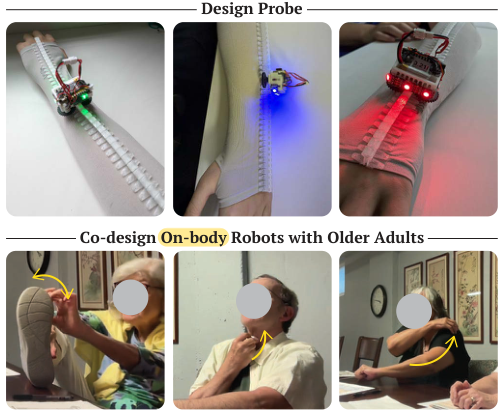
Calico design probe and co-design sessions with older adults.

Calico made the idea of on-body robots tangible, giving older adults something concrete to react to, critique, and design with.

Victor Nikhil Antony, Clara Jeon, Jiasheng Li, Ge Gao, Huaishu Peng, Anastasia K. Ostrowski, Chien-Ming Huang

arXiv 2025 · Participatory Design of On-Body Robots with Older Adults
13
Older adults in the co-design study, ages 66–84
6
Workshops across two phases of divergence and convergence
4
Co-designed robot concepts spanning walking, massage, and PT
3
Design principles distilled from participant reactions

The question was not just what an on-body robot could do, but how it should exist on a person.

Passive wearables already sense, track, and notify. On-body robots introduce something different: mobility, proximity, and the potential for embodied intervention. That makes this a design problem as much as a technical one. Before building products, the project had to surface the social norms, bodily constraints, and expectations that would make this category acceptable.

Why older adults Co-designers

The populations most likely to benefit also face the sharpest constraints around mobility, trust, stigma, and comfort.

Why Calico Probe

Calico turned an otherwise speculative concept into a tangible artifact people could wear, watch, and design around.

Why this matters New category

On-body robots create questions about placement, communication, and social acceptability that neither wearables nor nearby robots resolve on their own.

The workshops moved from opening the space wide to grounding specific robot futures.

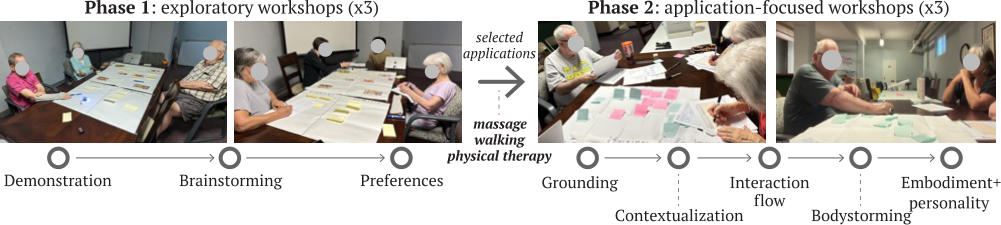
The process used two phases. First, participants explored what on-body robots could be. Then they converged around concrete applications and interaction flows through storyboarding and bodystorming.

Two-phase co-design process for on-body robots.

The co-design process moved from demonstration and broad ideation into grounding, contextualization, interaction flow, and bodystorming.

Phase 1: Diverge Breadth

Participants experienced Calico, mapped possible uses, and identified where on-body robots might matter in everyday life.

Phase 2: Converge Depth

Massage, physical therapy, and walking support were explored through concrete scenarios, start-to-end flows, and embodied enactment.

Older adults did not just react to examples. They designed four specific robot futures.

Each concept combined a role, a body location, a communication style, and a social identity. Together they show how wide the on-body design space really is.

Walking · Safety

Walking Sentinel

An ankle-adjacent robot that quietly supports navigation and fall prevention through rhythmic cues and escalating feedback.

  • Highlights environmental hazards
  • Escalates feedback as risk increases
  • Stays discreet enough for public use

Walking · Companionship

Pet-Like Walking Companion

A relational robot that makes going for a walk feel shared, with emotional cues and a clearer sense of beginning and ending.

  • Uses motion, light, and sound affectively
  • Feels companion-like rather than tool-like
  • Frames the walk as a relationship, not just a task

Recreation · Comfort

Expert Masseuse

A soft-bodied robot for sustained contact and targeted pressure, designed for comfort and relaxation rather than short utility bursts.

  • Uses softness and weight as assets
  • Adapts by body location
  • Treats extended use as desirable, not problematic

Rehabilitation · PT

Gamified PT Coach

A motivating physical therapy partner that turns repetition into feedback-rich play while adapting communication to body position.

  • Tracks effort and overexertion
  • Moves to the active body site
  • Relies on haptics when vision is blocked

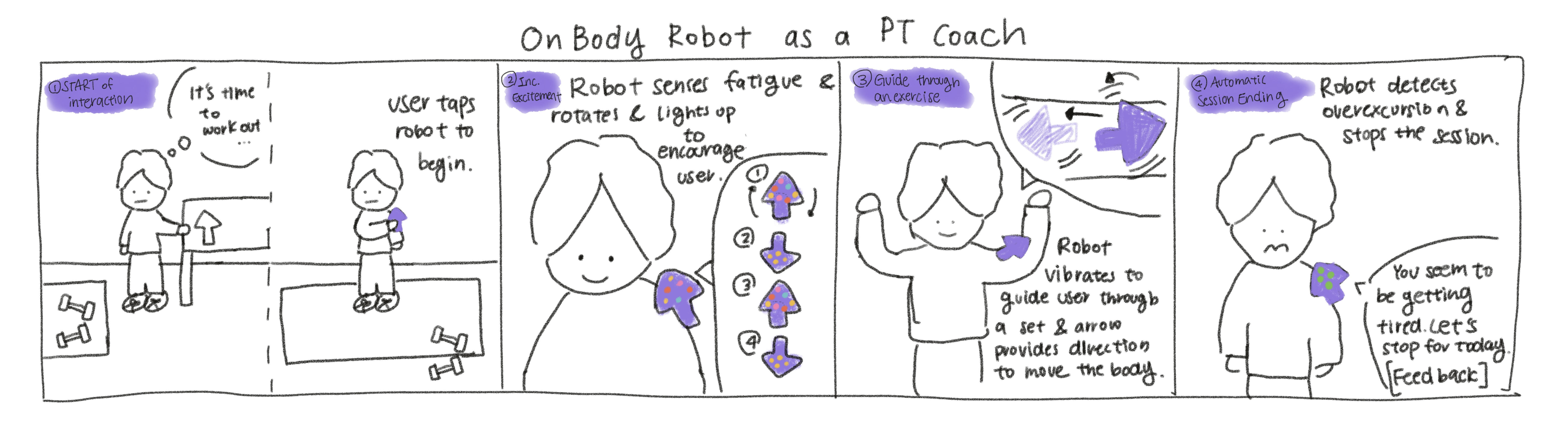
The PT storyboard shows how on-body robots combine mobility, sensing, and feedback in one interaction loop.

The co-designed PT coach is a useful example because it makes the value proposition legible: the robot travels to the body part being exercised and responds in place through multimodal feedback.

Co-designed storyboard for an on-body robot acting as a PT coach.

Storyboard for the Gamified PT Coach: beginning the routine, sensing fatigue, encouraging progress, and stopping when exertion becomes unsafe.

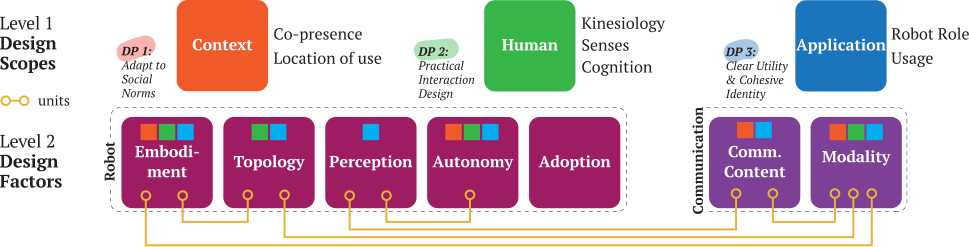
The project’s lasting output is a two-level design space for on-body robots.

The framework separates what constrains the design from what actually gets designed. It turns the workshops into something more reusable than four concepts alone.

Two-level design space for on-body robots.

Level 1 identifies the design scopes: Context, Human, and Application. Level 2 identifies the design factors: embodiment, topology, perception, autonomy, adoption, and communication.

Level 1: Scopes What constrains design

Context, human factors, and application shape what is plausible, acceptable, and useful before form decisions are even made.

Level 2: Factors What gets designed

Embodiment, topology, perception, autonomy, adoption, and communication define how the robot actually appears and behaves.

Three principles grounded the entire category.

These principles emerged from participant reactions to what felt awkward, unacceptable, inaccessible, or simply not worth wearing on the body.

01

Adapt to social norms

On-body robots have to navigate public visibility and stigma. Early designs need discretion, context-awareness, and the possibility of adornment.

02

Practical interaction design

The body changes what communication is possible. Placement, posture, sensory ability, and movement all determine how feedback can work.

03

Clear utility and cohesive identity

Mobility has to justify itself. The robot must offer something a static wearable cannot, while still feeling coherent enough to trust on the body.

The strongest design constraints came directly from what people found risky, awkward, or desirable.

"Outside, inside, my head is down because I'm scared to death that I'm going to hit uneven pavement."

Melanie (F/76) — on walking anxiety and the value of a sentinel-like robot

"In terms of aging eyes, losing eye sight... there has to be more than one way of communicating with you."

Raymond (M/76) — on multimodal feedback as a requirement

"If it's not good, you ask the robot to stop and it stops immediately... You're in control."

Norman (M/69) — on control as the foundation of trust

The project does not just propose examples. It gives on-body robotics a starting design language.

Calico and the workshops helped surface a design space, a set of concepts, and a practical framework for future on-body robots. The next step is not to re-ask whether the category exists, but to build from these grounded design directions.